About Me
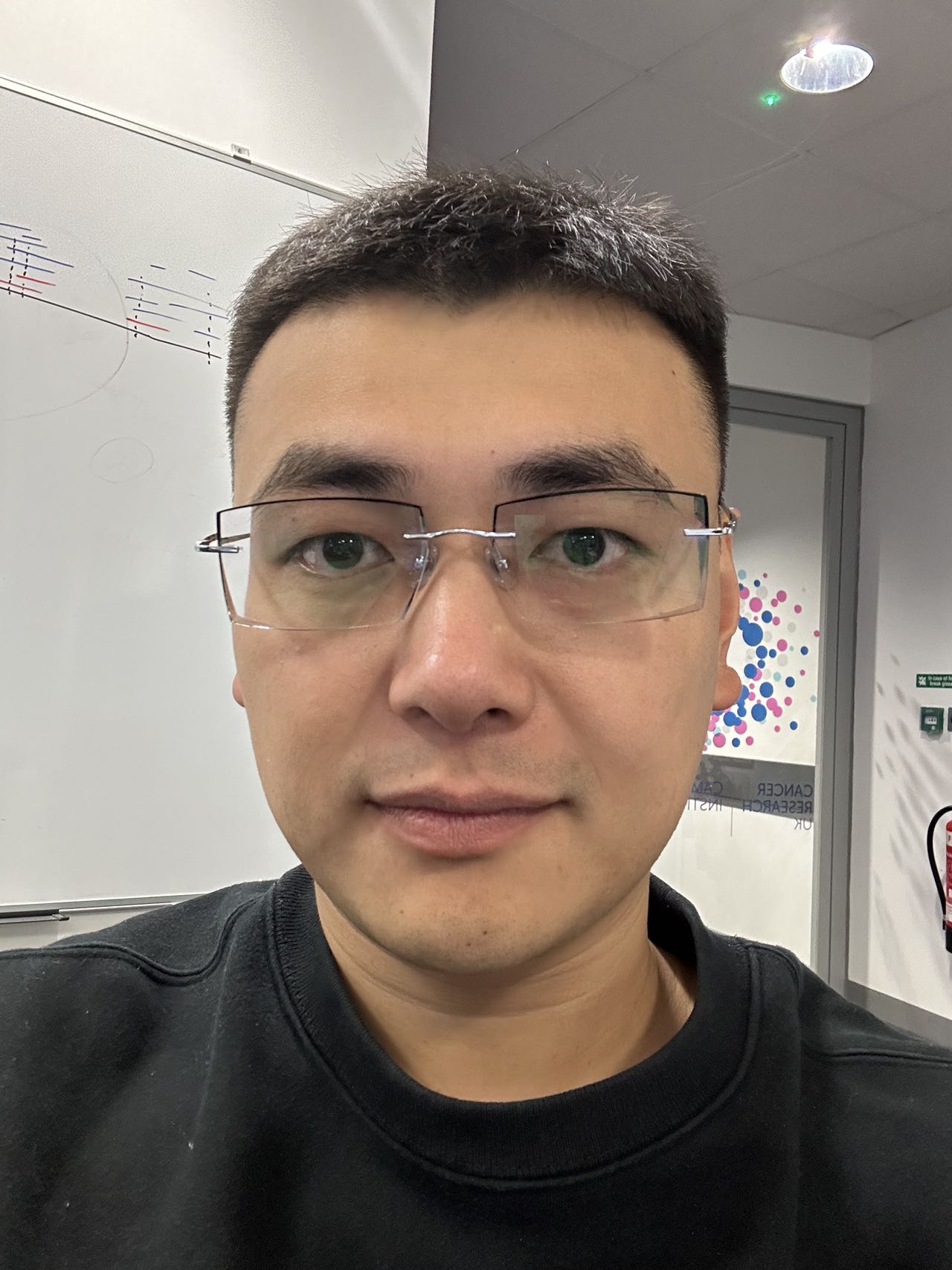
Zeyu Gao
I am a postdoctoral researcher in the Department of Oncology at the University of Cambridge, affiliated with the Crispin Lab, the CRUK Cambridge Centre, and the Early Cancer Institute. My work develops machine learning methods for whole-slide pathology, multimodal foundation models, spatial omics, and clinically relevant prediction from histopathology.
Foundation models, weak supervision, spatial transcriptomics, and robust whole-slide image analysis.
Cancer diagnosis, prognosis, molecular prediction, spatial quantification, and anomaly detection.
Method-driven work grounded in clinically meaningful pathology problems and translational impact.
Research Directions
Pathology foundation models
I study representation learning for pathology at scale, with an emphasis on adaptive region modeling, multimodal alignment, and data-efficient pretraining for whole-slide image analysis.
Spatial and molecular prediction
My recent work links tissue morphology with transcriptomic, proteomic, and spatial signals to improve biomarker prediction and tissue-level interpretation.
Weakly supervised slide analysis
I develop multi-instance, semi-supervised, and contrastive learning approaches that extract slide-level and region-level information from sparse or weak annotation.
Reliable clinical AI
I am interested in robustness, out-of-distribution detection, explainability, and deployment-oriented evaluation for computational pathology systems.
Featured Publications
 2026
2026CARE
A molecular-guided pathology foundation model with adaptive region modeling for whole-slide image analysis across 33 downstream tasks.
 2026
2026PH2ST
A spatial transcriptomics-guided hypergraph framework that uses limited ST signals to drive multi-scale histological learning.
 2025
2025SMMILe
A measurable multi-instance learning framework for accurate spatial quantification and clinically useful pathology analysis.
 2023
2023Childhood leukemia classification via information bottleneck enhanced hierarchical multi-instance learning
A hierarchical multi-instance learning framework with an information bottleneck for patient-level leukemia classification from bone marrow smears.
2023A semi-supervised multi-task learning framework for cancer classification with weak annotation in whole-slide images
A semi-supervised multi-task framework that jointly learns cancer region detection and subtype classification under weak supervision in whole-slide images.
2022Unsupervised representation learning for tissue segmentation in histopathological images: From global to local contrast
An unsupervised multi-granularity representation learning framework for tissue segmentation in histopathology.
 2021
2021Nuclei grading of clear cell renal cell carcinoma in histopathological image by composite high-resolution network
A composite high-resolution framework for nuclei grading in clear cell renal cell carcinoma pathology images.
2021Instance-based vision transformer for subtyping of papillary renal cell carcinoma in histopathological image
An instance-based vision transformer for fine-grained papillary renal cell carcinoma subtyping from histopathological images.
2020Renal cell carcinoma detection and subtyping with minimal point-based annotation in whole-slide images
A weakly supervised framework showing how minimal point annotations can support effective renal cancer detection and subtyping on whole-slide images.
Selected Talks and Presentations
- March 2026 · Multimodal Foundation Models
Invited webinar talk for the 5th Artificial Intelligence in Precision Oncology webinar series.
- September 2025 · Multimodal AI for Cancer Research
Invited talk at the ESMO Molecular Analysis for Precision Oncology Congress in Paris.
- August 2025 · Multiomics for Cancer
Invited lecture at Oxford ML School 2025.
- June 2025 · Multimodal and Multiomics Foundation Models
Invited lecture at the Artificial Intelligence in Cancer Research Summer School 2025 in Corfu.
Recent Highlights
Background
Training
I received my Ph.D. in Computer Science from Xi’an Jiaotong University in 2023, jointly trained by the School of Computer Science and the School of Mathematics and Statistics under the supervision of Prof. Chen Li and Prof. Deyu Meng. Before that, I completed my M.S. in Artificial Intelligence at Xidian University under the supervision of Prof. Xiangrong Zhang, as well as my B.S. in Electronic Engineering there.
Selected Honors
Postdoctoral Fellow, Trinity College Cambridge (2024-2026); Excellent Postgraduate of Xi’an Jiaotong University (2021-2022); MICCAI Student Travel Award (2021).